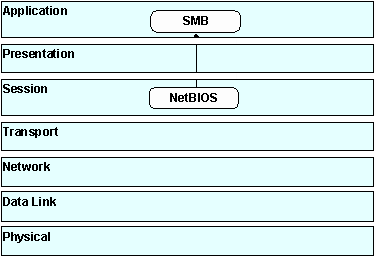
The Network Basic I/O System
(NetBIOS), TCP/UDP version, was developed for the IBM PC
LAN program to support communications between symbolically
named stations and transfer of arbitrary data.
The Server Message Block (SMB)
is a Microsoft presentation layer protocol providing file
and print sharing functions for LAN Manager, VINES and other
network operating systems. IBM NetBIOS manages the use of
node names and transport layer connections for higher layer
protocols such as SMB. The IBM suite includes the following
protocols:
NetBIOS provides a communication
interface between the application program and the attached
medium. All communication functions from the physical layer
through the session layer are handled by NetBIOS, the adapter
support software, and the adapter card. A NetBIOS session
is a logical connection between any two names on the network.
It is described in IBM - Local Area Network Technical Reference
1990 DA-30/31 Protocol Operating Manual. It is usually encapsulated
over LLC.
(Compliant with IBM - Local Area Network Technical Reference 1990 DA-30/31
Protocol Operating Manual NetBIOS Decode.)
The format of the header is shown
in the following illustration:
Server
Message Block (SMB) is a Microsoft presentation layer protocol
providing file and print sharing functions for LAN Manager,
Banyan VINES and other network operating systems. IBM NetBIOS
manages the use of node names and transport layer connections
for higher layer protocols such as SMB.
SMB is used for sharing files,
printers, serial ports, and communications abstractions such
as named pipes and mail slots between computers. It is a
client server request-response protocol. Clients connect
to servers using TCP/IP. They can then send commands (SMBs)
to the server that allow them to access shares, open files,
etc. over the network.
Many protocol variants have been
developed. The first protocol variant was the Core Protocol,
known also as PC NETWORK PROGRAM 1.0. It handled a fairly
basic set of operations that included:
There are several different versions and
sub-versions of this protocol. A particular version is referred
to as a dialect. When two machines first come into network
contact they negotiate the dialect to be used. Different
dialects can include both new messages as well as changes
to the fields and semantics of existing messages in other
dialects. Each server makes a set of resources available
to clients on the network. A resource being shared may be
a directory tree, named pipe, printer, etc. So far as clients
are concerned, the server has no storage or service dependencies
on any other servers; a client considers the server to be
the sole provider of the resource being used.
The SMB protocol requires server authentication
of users before file accesses are allowed, and each server
authenticates its own users. A client system must send authentication
information to the server before the server will allow access
to its resources.
The general format of the header is shown
in the following illustration:
Command |
Description |
[bad
command] |
Invalid
SMB command. |
[bind
(UNIX)] |
Obtain
file system address for file. |
[cancel
forward] |
Cancel
server recognition of name. |
[change/check
dir] |
Change
to directory or check path. |
[change
group] |
Change
group association of user. |
[change
password] |
Change
password of user. |
[close
file] |
Close
file handle and flush buffers. |
[close
spoolfile] |
Close
print buffer file. |
[consumer
logon] |
Log
on with consumer validation. |
[copy
file] |
Copy
file to specified path. |
[copy
new path] |
Copy
file to new path name. |
[create & bind] |
Create
file and get file system address. |
[create
directory] |
Create
new directory. |
[create
file] |
Create
new or open existing file. |
[delete
dir] |
Delete
the specified directory. |
[delete
file] |
Delete
the specified file. |
[echo] |
Request
echo from server. |
[find & close] |
Search
for file and close directory (UNIX). |
[find & close
/2] |
Search
for file and close directory (OS/2). |
[find
first file] |
Find
first matching file (OS/2). |
[find
unique] |
Search
directory for specified file. |
[flush
file] |
Flush
all file buffers to disk. |
[fork
to PID] |
Provide
same access rights to new process. |
[forward
name] |
Cause
server to accept messages for name. |
[get
access right] |
Get
access rights for specified file. |
[get
exp attribs] |
Get
expanded attributes for file (OS/2). |
[get
unix attribs] |
Get
expanded attributes for file (UNIX). |
[get
file attribs] |
Get
attributes for specified file. |
[get
file queue] |
Get
print queue listing. |
[get
group info] |
Get
logical group associations. |
[get
machine name] |
Get
machine name for block messages. |
[get
pathname] |
Get
path of specified handle. |
[get
resources] |
Get
availability of server resources. |
[get
server info] |
Get
total and free space for server disk. |
[get
user info] |
Get
logical user associations. |
[IOCTL] |
Initiate
I/O control for DOS-OS/2 devices. |
[IOCTL
next] |
Initiates
subsequent I/O control for DOS-OS/2 devices. |
[IOCTL
(UNIX)] |
I/O
control for UNIX-Xenix devices. |
[link
file] |
Make
an additional path to a file. |
[lock
and read] |
Lock
and read byte range. |
[lock
bytes] |
Lock
specified byte range. |
[lock/unlock & X] |
Lock/unlock
bytes and execute next command. |
[logoff & execute] |
Log
off and execute next command. |
[mail
announce] |
Query
availability of server nodes. |
[mailslot
message] |
Mail
slot transaction message. |
[make/bind
dir] |
Make
dir and get file system address. |
[make
temp file] |
Make
temporary data file. |
[make
new file] |
Make
new file only if it does not exist. |
[make
node] |
Make
file for use as a device. |
[move
file] |
Move
file to specified path (OS/2). |
[move
new path] |
Move
file to specified path (UNIX/Xenix). |
[multi-block
data] |
Send
data for multi-block message. |
[multi-block
end] |
Terminate
multi-block message. |
[multi-block
hdr] |
Send
header for multi-block message. |
[named
pipe call] |
Open,
write, read, or close named pipe. |
[named
pipe wait] |
Wait
for named pipe to become ready. |
[named
pipe peek] |
Look
at named pipe data. |
[named
pipe query] |
Query
named pipe handle modes. |
[named
pipe set] |
Set
named pipe handle modes. |
[named
pipe attr] |
Query
named pipe attributes. |
[named
pipe R/W] |
Named
pipe read/write transaction. |
[named
pipe read] |
Raw
mode named pipe read. |
[named
pipe write] |
Raw
mode named pipe write. |
[negotiate
protoc] |
Negotiate
SMB protocol version. |
[newfile & bind] |
Make
new file and get file system address. |
[notify
close] |
Close
handle used to monitor file changes. |
[open
file] |
Open
specified file. |
[open & execute] |
Open
specified file and execute next command. |
[open
spoolfile] |
Open
specified print buffer file. |
[process
exit] |
Terminate
consumer process. |
[read & execute] |
Read
file and execute next command. |
[read
and hide] |
Read
directory ignoring hidden files. |
[read
block mplex] |
Read
block data on multiplexed connection. |
[read
block raw] |
Read
block data on unique connection. |
[read
block sec/r] |
Read
block secondary response. |
[read
check] |
Check
file accessibility. |
[read
from file] |
Read
from specified file. |
[read
w/options] |
Read
from file with specified options. |
[rename
file] |
Rename
the specified file to a new name. |
[reserve
resourcs] |
Reserve
resources on the server. |
[search
dir] |
Search
directory with specified attribute. |
[seek] |
Set
file pointer for handle. |
[send
broadcast] |
Send
a one block broadcast message. |
[session
setup] |
Log-in
with consumer-based authentication. |
[set
exp attrib] |
Set
expanded file attributes (OS/2). |
[set
unix attribs] |
Set
expanded file attributes (UNIX/Xenix). |
[set
file attribs] |
Set
normal file attributes. |
[single
block msg] |
Send
a single block message. |
[transaction
next] |
Subsequent
name transaction. |
[tree & execute] |
Make
virtual connection and execute next command. |
[tree
connect] |
Make
a virtual connection. |
[tree
disconect] |
Detach
a virtual connection. |
[unbind] |
Discard
file system address binding. |
[unlock
bytes] |
Release
a locked byte range. |
[write & close] |
Write
to and close specified file handle. |
[write & execute] |
Write
to file and execute next command. |
[write & unlock] |
Write
to and unlock a byte range. |
[write
block raw] |
Write
block data on unique connection. |
[write
block mplx] |
Write
block data on multiplexed connection. |
[write
block sec] |
Write
block secondary request. |
[write
complete] |
Terminate
a write block sequence. |
[write
spoolfile] |
Write
to the specified print buffer. |
[write
to file] |
Write
to the specified file handle. |
[X2
open file] |
Open
file. |
[X2
find first] |
Find
first file. |
[X2
find next] |
Find
next file. |
[X2
query FS] |
Get
file system information. |
[X2
set FS info] |
Set
file system information. |
[X2
query path] |
Get
information on path. |
[X2
set path] |
Set
path information. |
[X2
query file] |
Get
file information. |
[X2
set info] |
Set
file information. |
[X2
FS control] |
File
system control information. |
[X2
IOCTL] |
I/O
control for devices. |
[X2
notify] |
Monitor
file for changes. |
[X2
notify next] |
Subsequent
file monitoring. |
[X2
make dir] |
Make
directory. |
Error
Class |
Name |
Source
of Error |
0 |
|
No
error, or error was handled by system. |
1 |
ERRDOS |
Server
operating system. |
2 |
ERRSRV |
Server
network file manager. |
3 |
ERRHRD |
System
or device. |
4 |
ERRXOS |
Extended
operating system. |
225-227 |
ERRRMX |
RMX
operating system. |
255 |
ERRCMD |
Invalid
SMB commands. |
Error
Message |
Description |
{Access
denied} |
Unable
to service request. |
{Access
list full} |
Access
control list full. |
{Bad
attrib mode} |
Invalid
attributes specified. |
{Bad
disk request} |
Disk
command invalid. |
{Bad
drive spec} |
Specified
drive invalid. |
{Bad
environment} |
Environment
invalid. |
{Bad
EXE file} |
Bad
executable file format. |
{Bad
file access} |
Invalid
access to read only file. |
{Bad
file ID} |
File
handle invalid. |
{Bad
filespec} |
Path
name invalid. |
{Bad
format} |
Format
invalid. |
{Bad
function} |
Function
not supported. |
{Bad
I/O data} |
Data
invalid on server I/O device. |
{Bad
math argument} |
Math
argument invalid. |
{Bad
media type} |
Unknown
media type. |
{Bad
memory block} |
Memory
block address invalid. |
{Bad
open mode} |
Open
mode invalid. |
{Bad
permissions} |
Specified
permissions invalid. |
{Bad
print FID} |
Print
file ID invalid. |
{Bad
print request} |
Printer
device request invalid. |
{Bad
reqst length} |
Bad
request structure length. |
{Bad
semaphore} |
Semaphore
identifier invalid. |
{Bad
SMB command} |
SMB
command invalid. |
{Bad
Tree ID} |
Tree
ID invalid. |
{Bad
User ID} |
User
ID invalid. |
{Bad
user/passwrd} |
Bad
password or user name. |
{Bad
wait done} |
Wait
done for unwaited process. |
{Continue
in MPX} |
Continue
in block multiplexed mode. |
{Can’t
delete dir} |
Cannot
delete current directory. |
{Can’t
init net} |
Network
cannot be initialized. |
{Can’t
mount dev} |
Device
cannot be mounted. |
{Can’t
RAW, do MPX} |
Cannot
use raw blocks, use multiplexed. |
{Can’t
ren to vol} |
Attempt
to rename across volumes failed. |
{Can’t
support RAW} |
Cannot
support raw block access. |
{Can’t
write dir} |
Attempt
to write on a directory failed. |
{Command
not recvd} |
Initial
command not received. |
{CRC
data error} |
Data
CRC error on device. |
{Dev
out of space} |
Device
out of space. |
{Device
is remote} |
Referenced
device remote. |
{Dir
not found} |
Directory
not found. |
{Disk
write error} |
Disk
write fault. |
{Disk
read error} |
Disk
read fault. |
{Disk
seek error} |
Disk
seek error. |
{Drive
not ready} |
Drive
not ready. |
{Dup
filename} |
File
name already exists. |
{EOF
on printer} |
End
of file found on print queue dump. |
{Err
buffered} |
Error
message buffered. |
{Err
logged} |
Error
message logged. |
{Err
displayed} |
Error
message displayed. |
{File
not found} |
Filespec
not found. |
{File
too big} |
Maximum
file size exceeded. |
{Gen
disk failure} |
General
disk failure. |
{Insuf
acc rights} |
Insufficient
access rights. |
{Invalid
name} |
Invalid
name supplied on tree connect. |
{Invalid
pipe} |
Invalid
pipe specified. |
{Lock
conflict} |
Lock/Unlock
conflicts with other locks. |
{Memory
blks lost} |
Memory
control blocks destroyed. |
{More
data coming} |
Cannot
terminate; more data coming. |
{Need
block device} |
File
used where a block device needed. |
{Need
data file} |
Must
specify data file. |
{No
FCBs available} |
Out
of file control blocks. |
{No
more files} |
No
more matching files found. |
{No
proc to pipe} |
No
process available to pipe. |
{No
read process} |
Write
to a pipe with no read processes. |
{No
resources} |
Server
out of resources. |
{No
room f/message} |
No
room to buffer message. |
{Not
a directory} |
Must
specify directory. |
{Not
receiving} |
Not
receiving messages. |
{No
semaphores} |
Semaphore
not available. |
{OK} |
SMB
command completed successfully. |
{Out
of disk space} |
Print
queue out of disk space. |
{Out
of handles} |
Too
many open files. |
{Out
of memory} |
Insufficient
memory on server. |
{Out
of paper} |
Printer
out of paper. |
{Pipe
is busy} |
Pipe
process busy; wait. |
{Pipe
is closing} |
Terminating
pipe process. |
{Print
Q full} |
Print
file queue table full. |
{Proc
table full} |
Server
process table full. |
{Rem
I/O error} |
Remote
I/O error. |
{Sector
not found} |
Sector
not found. |
{Seek
on pipe} |
Seek
was issued to a pipe. |
{Server
error} |
General
server error. |
{Server
paused} |
Server
paused. |
{Share
buffer out} |
Share
buffer out of space. |
{Share
conflict} |
Share
conflicts with existing files. |
{Syntax
error} |
Syntax
error in path name. |
{Sys
call intruptd} |
Interrupted
system call. |
{Table
overflow} |
Internal
table overflow. |
{Terminal
needed} |
Terminal
device required. |
{Timed
out} |
Operation
has run out of time. |
{Too
many links} |
Too
many links. |
{Too
many names} |
Too
many remote user names. |
{Too
many UIDs} |
User
ID limit exceeded. |
{Unit
unknown} |
Unknown
unit. |
{Unknown
error} |
Non-specific
error. |
{Unknwn
process} |
No
such process. |
{Write
protected} |
Write
on write-protected diskette. |
{Wrong
diskette} |
Wrong
diskette inserted in drive. |