


Bubble packets: conexiones peer-to-peer entre dos máquinas protegidas por NAT (AKA cómo funcionan iChat AV y Skype con NAT)
(artículo original y referencia original)To send an initial communication packet from Teredo Client A to Teredo Client B, the following process is used:
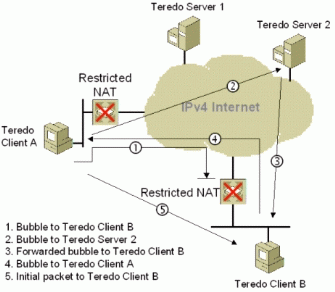
- Teredo Client A sends a bubble packet directly to Teredo Client B. A bubble packet contains no data and is used to create or maintain NAT mappings. Because Teredo Client B is behind a restricted NAT, Teredo traffic from an arbitrary source IPv4 address and UDP port number is not allowed unless there is a source-specific NAT translation table entry. Assuming that there is none, the restricted NAT silently discards the bubble packet. However, when the restricted NAT for Teredo Client A forwarded the bubble packet, it created a source-specific NAT translation table entry that will allow future packets sent from Teredo Client B to be forwarded to Teredo Client A.
- Teredo Client A sends a bubble packet to Teredo Client B through Teredo Server 2 (Teredo Client B's Teredo server). The IPv4 destination address in the bubble packet is set to the IPv4 address of Teredo Server 2, which Teredo Client A determines from the third and fourth blocks of Teredo Client B's Teredo address.
- Teredo Server 2 forwards the bubble packet to Teredo Client B. The restricted NAT for Teredo Client B forwards the packet because there is an existing source-specific mapping for Teredo traffic from Teredo Server 2 (established by the initial configuration of Teredo Client B).
- Teredo Client B responds to the bubble packet received from Teredo Client A with its own bubble packet, which is sent directly to Teredo Client A. Because Teredo Client A's restricted NAT has a source-specific mapping for Teredo traffic from Teredo Client B (as established by the initial bubble packet sent from Teredo Client A in step 1), it forwards the bubble packet to Teredo Client A.
- Upon receipt of the bubble packet from Teredo Client B, Teredo Client A determines that source-specific NAT mappings exist for both NATs. Teredo Client A sends an initial communication packet directly to Teredo Client B.
This process occurs transparently to the user at Teredo Client A.